Acquisition
Where: /modules/marketing/acquisition — under Analytics, right
after the overview.
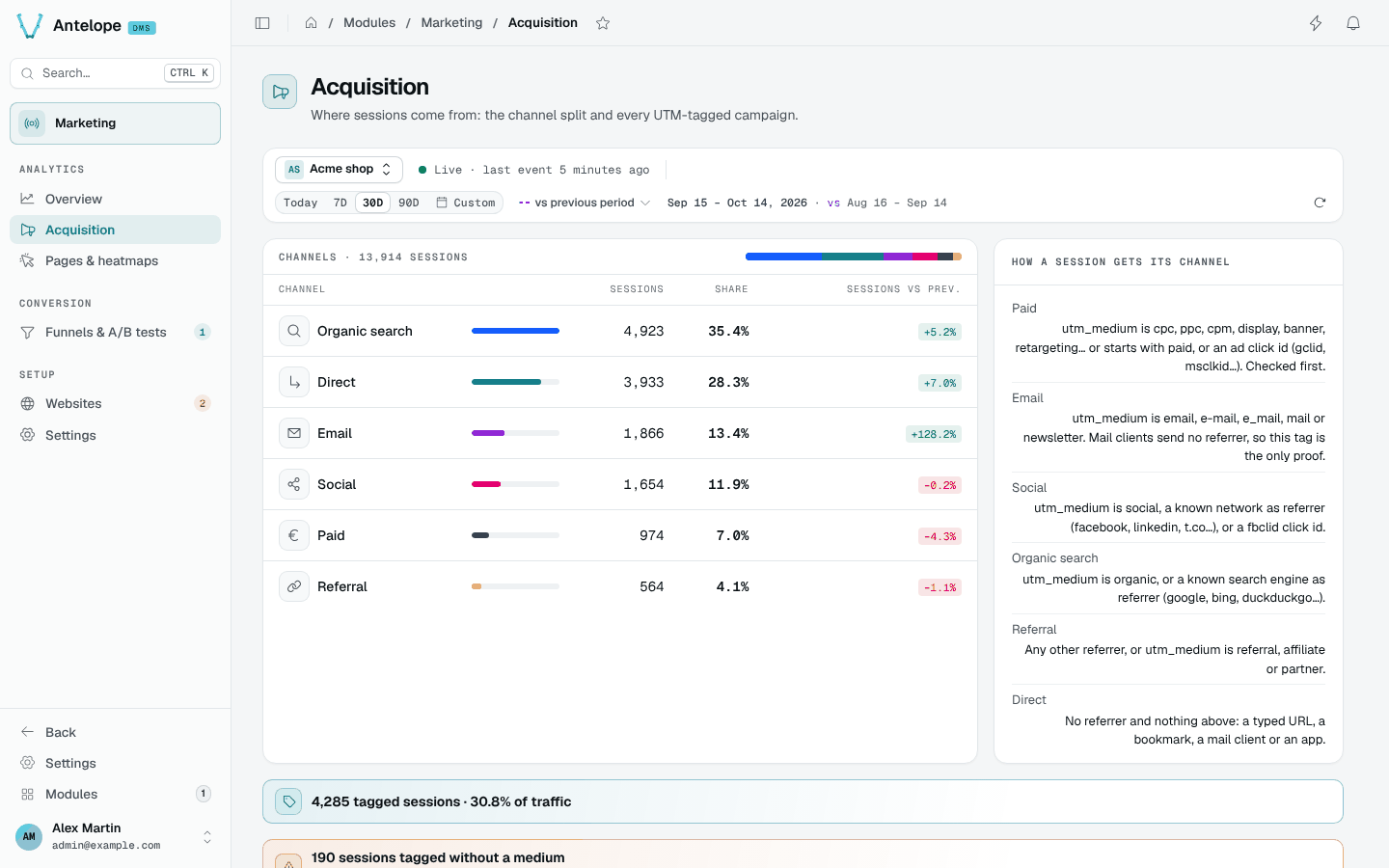
The overview says how much traffic came; this page says where it came from: the six-channel split of sessions, the UTM campaign table, and the referrer and UTM details behind them. It reads the website and period of the context bar.
What it shows
- Channels — sessions grouped as direct / organic / social / email /
referral / paid, each with its share and its change against the
comparison window. Every channel is listed, even at zero. The channel is
not something the tracker sends: it is a pure mapping of the session's
referrer domain,
utm_mediumand ad click id, applied when the session is counted (see below). Beside the card, How a session gets its channel states the rules. A channel's row opens that channel's tab of the campaigns table (?campaigns.tab=<channel>, a link that can be shared). - UTM campaigns table — one row per (source, medium, campaign)
triple observed on new sessions and the channel those sessions were
counted under (referrer and click id included, so a row agrees with the
channels card), ranked by sessions, with its share of the period's
sessions and a sessions-per-day sparkline. A triple whose sessions landed
in two channels —
utm_source=facebookfrom the app (Direct) and from facebook.com (Social) — takes two rows. "not set" is a UTM parameter the landing URL did not carry —?utm_source=newsletteralone is a real campaign row. UTM values are trimmed, and source and medium lower-cased, soEmailandemailare one medium. The route searches, filters, sorts and pages every row of the period: the tabs, their counters and the footer count cover all of them. A banner above the table gives the tagged sessions and their share of all traffic. - Missing medium — a row tagged without
utm_mediumis flagged, and a banner above the table counts its sessions: with no medium they classify by referrer alone, which makes them Direct when the link carried no referrer — a mail client never sends one. Addingutm_mediumto the link fixes it for the sessions to come. - No visit yet — while the website has sent no pageview, a banner over the page says so and links to the install guide.
- Top referrers / UTM contents / UTM terms — the external referrer
domains counted on new sessions (all channels, not just the referral
slice; link-shim and mobile hosts such as
l.facebook.comorm.youtube.comcount as their network), each with its share of the period's sessions, plusutm_contentandutm_term, the two parameters that do not take part in the triple, as top lists.
How channels are classified
Applied in order; the first match wins:
| Channel | Matches |
|---|---|
| paid | utm_medium in cpc, ppc, cpm, cpv, cpa, cpp, sem, display, banner, retargeting — or starting with paid (paid-social, paid_search…) — or an ad click id on the landing URL (gclid, gbraid, wbraid, dclid, msclkid, ttclid, twclid, li_fat_id) |
utm_medium in email, e-mail, e_mail, newsletter, mail | |
| social | utm_medium spelling out social, the referrer being a known social network (facebook, instagram, x/twitter, linkedin, reddit, tiktok, youtube… including shorteners like t.co), or a fbclid/igshid click id |
| organic | utm_medium=organic, or the referrer being a known search engine (google, bing, duckduckgo, yahoo, baidu, yandex…) |
| referral | any other external referrer, or utm_medium in referral, affiliate, partner — with or without a referrer |
| direct | no referrer, nothing matched |
Paid is checked first on purpose: an ad click keeps its google.com or
facebook.com referrer and would otherwise read as organic or social.
Email comes next, on its medium alone: a desktop mail client sends no
referrer and a webmail sends its own host, so without the tag the session
would read as direct or referral. A medium the mapping does not know keeps
referrer semantics — referral with a referrer, direct without one.
The mapping runs when the session's rollup fires, and the channel is stored nowhere but in the campaign key of the rollup — so refining the mapping needs no migration, but it never reclassifies the past either: sessions already rolled up keep the channel they got, and only sessions counted after the change classify by the new rules. Email and the referral mediums arrived that way; days rolled up before them count those sessions as direct or referral.
Where the numbers come from
Same source as the overview — the daily rollups, never raw events — so the same caveats apply (Overview):
- A day keeps at most
MAX_ENTRIES_PER_TOP_MAP(50) campaign triples; long-tail campaigns on high-cardinality days are approximate. Campaign keys rolled up before the channel joined them are left out of the table. - Top maps are kept
TOP_MAPS_RETENTION_DAYS(a year plus 90 days), long enough for a 90-day window compared with the previous year. A comparison reaching days whose maps were emptied earlier shows no change, and the channels card says why. - Dimensions start at their ship date. Days rolled up before the campaign and channel dimensions existed contribute nothing to this page; a window overlapping that boundary undercounts campaigns, never traffic.
- Sessions carrying no UTM at all appear in the channels card (as direct, organic, social or referral) but never in the campaigns table.