Introduction
@antelopejs/dms-automation is the visual automation builder of the AntelopeJS DMS. A procedure is a graph of nodes: a trigger (a schedule, a webhook, a click, a DMS event) starts it, actions do the work (an HTTP call, an e-mail, a notification), and data nodes shape the values in between. The module runs procedures, keeps every run with its trace, and tells you which ones need attention.
What it brings
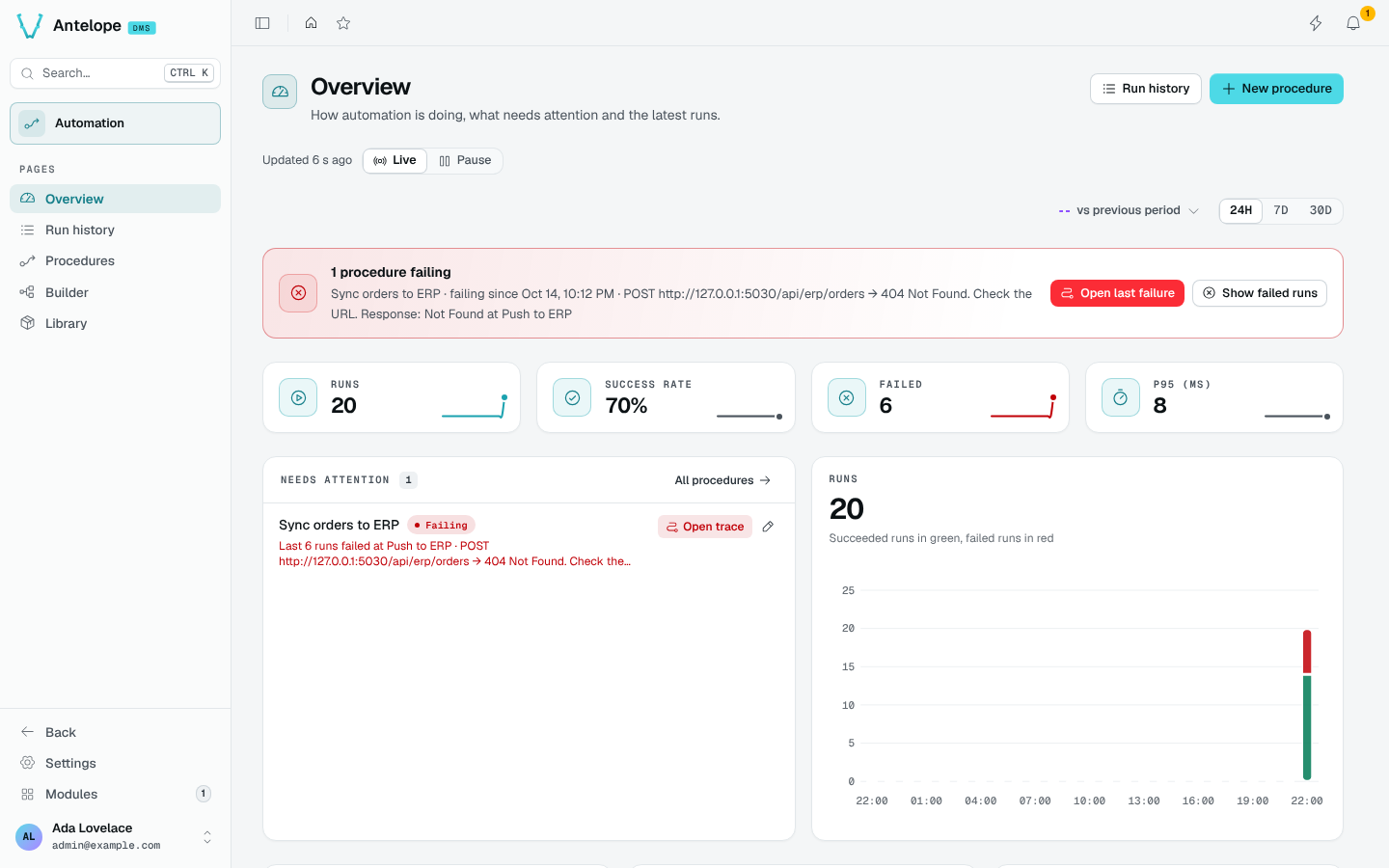
Overview
The health of every procedure in one line, KPIs over 24 h, 7 d or 30 d, what needs attention and why.
Procedures
Every procedure with its state, its last runs, success rate and trigger; new and import dialogs.
Building blocks
| Kind | Examples | Role |
|---|---|---|
| Triggers | Manual, Schedule (cron), Webhook, DMS events (member added, user registered, record created…) | Start a run with a payload. |
| Actions | HTTP request, Log, Send email, Send notification, Invite user | Do something, in order along trigger edges. |
| Flow | If, Switch, For each, For range, Parallel, Try/Catch, Retry, Delay, Set variable | Branch, loop and recover. |
| Data nodes | Constants, math, comparisons, booleans, strings, objects, JSON | Compute values wired into fields along data edges. |
| Templates | Your own reusable groups of nodes | Share a sub-graph between procedures. |
Other modules add their own nodes through @antelopejs/interface-dms-automation: @antelopejs/dms-database adds a Table watch trigger, @antelopejs/dms-api a Route unhealthy trigger and two actions.
Who it is for
The pages, like every DMS module page, belong to the platform owner, and so does the module's API.
Requirements
@antelopejs/dms0.9 (@antelopejs/interface-dms0.7) and@antelopejs/dms-frontend0.6. Version 0.4 of the module is the first one for this release; use 0.3 with DMS 0.8.- An API provider (
@antelopejs/api) for webhooks, and a database implementation. - Optional:
@antelopejs/interface-redis, to run several instances. See Clustering.