Run the DMS inside AdonisJS
template-dms-adonis runs the DMS as a guest of an AdonisJS 6 application. Pick it when you already have, or want, an AdonisJS app that owns the HTTP server, signals, logger and configuration. For a new application without that constraint, start from template-dms-demo: it supports hot reload for the dashboard and every ajs command.
Standalone and embedded modes
In standalone mode the ajs CLI owns the process and reads the modules from antelope.config.ts; this is what template-dms-demo uses. In embedded mode your application owns the process and starts the runtime with createRuntime() from @antelopejs/core, with the modules listed in code. The Embedded runtime concept page compares the two.
In the template, providers/antelope_provider.ts creates the runtime in register(), starts it in start() and stops it in shutdown(), so the DMS follows the AdonisJS lifecycle.
Start the backend and dashboard
You need Node.js 22 or later, pnpm, and a MongoDB server on mongodb://localhost:27017 (MONGODB_URL in .env).
git clone https://github.com/AntelopeJS/template-dms-adonis.git my-app
cd my-app
pnpm install --frozen-lockfile
cp .env.example .env
node ace generate:key
Start AdonisJS and the embedded DMS:
pnpm dev
AdonisJS listens on http://localhost:3333 and the DMS API on http://localhost:5010. While the backend runs, build and start the dashboard in a second terminal:
pnpm frontend:build
pnpm frontend:start
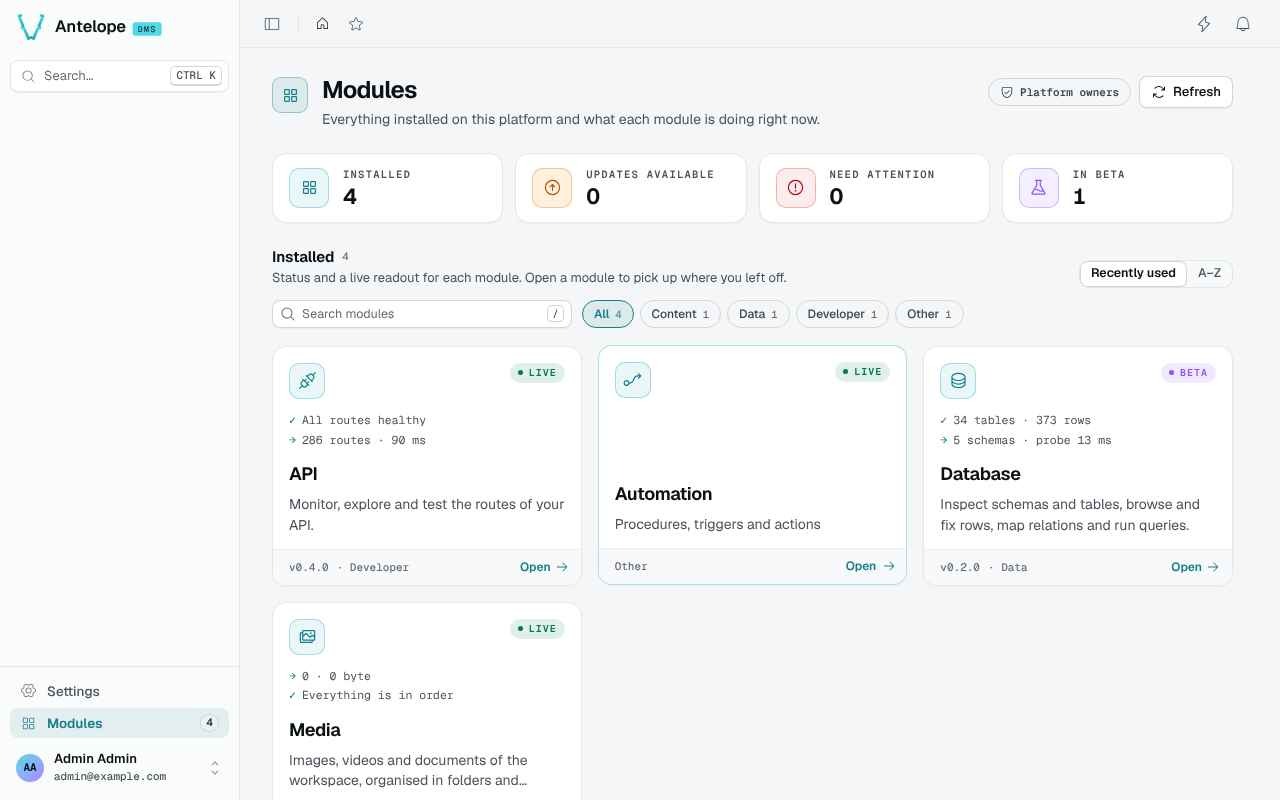
Open http://localhost:3001. On a fresh database, the first-run wizard creates your administrator account; after that, the dashboard shows the sign-in page.
The .env file holds the secrets the two processes share: DMS_BOOTSTRAP_SECRET is the DMS frontend.bootstrapSecret the dashboard presents to the backend, and DMS_SESSION_SECRET (at least 32 characters) signs the dashboard sessions. DMS_COOKIE_SECURE=false lets the session cookie work over plain http locally; remove it behind TLS. Replace every development secret before you deploy. Frontend CLI covers ajs dms build, ajs dms start and their variables.
Add a DMS module
In embedded mode the provider's code is the module list, so ajs project modules add does not apply. To add a module such as @antelopejs/dms-lang:
Install the package
pnpm add @antelopejs/dms-lang
The runtime loads modules from the application's node_modules (or a local path), not from the ~/.antelopejs cache.
List it in the provider
Add an entry to the modules map of providers/antelope_provider.ts, with its configuration under config:
this.runtime = createRuntime({
  projectFolder: this.app.makePath(),
  modules: {
    '@antelopejs/dms': { config: { /* ... */ } },
    '@antelopejs/dms-lang': {},
    // ...
  },
  uses: ['@antelopejs/interface-dms'],
})
Restart and rebuild the dashboard
Restart pnpm dev, then run pnpm frontend:build and pnpm frontend:start again: the build bundles the frontend modules the backend serves, so a module added or removed after the last build does not show until you rebuild.
Application code reaches the DMS through runtime.use(), never by importing an @antelopejs/interface-* package directly; the template's GET /dms/info route in start/routes.ts shows the pattern.
Limitations
Embedded mode trades the ajs tooling for control over the process. The Embedded runtime guide details each point:
- No
ajs dms dev. The embedded runtime forcesdev: false, so the DMS does not publish the layer source paths the dashboard's hot-reload server needs. Build and start the dashboard instead, and rebuild after a module change. - A separate API port.
@antelopejs/apilistens on its own port (DMS_API_PORT,5010by default), not inside the AdonisJS HTTP server, and needspublicBaseUrlset to the origin browsers reach it at. - No module hot reload. With
dev: false, DMS modules load once per runtime start: restartpnpm devafter changing the module list or a module's configuration. - No
ajs projectcommands,envOverridesorenvironments: configure modules in the provider, from AdonisJS'senv.
Tested versions
| Package | Version |
|---|---|
AdonisJS (@adonisjs/core) | 6 |
@antelopejs/core | 1.15.2 |
@antelopejs/dms | 0.9.2 |
@antelopejs/dms-frontend | 0.6.1 |
Only AdonisJS 6 is tested. Other Node.js hosts (Express, Fastify, NestJS) follow the same principle, described in the framework guide.
Built-in dashboard
What the DMS ships before you write a single page — the shell, onboarding, auth screens, user settings, team management, and the platform housekeeping.
Overview
Everything you do when you build on the DMS — set up the project, declare pages and navigation, wire actions and services, translate, ship custom Vue, package and deploy.